Most sourcing agents don't charge you much, sometimes nothing at all. That's the tell. They earn from the factory side: a margin built into the unit price you never see, typically anywhere from 15% to 50%. You're not paying the agent. The factory is, out of the price it quotes you. Which means the person you hired to get you the best price has a direct financial reason not to.
The mechanics, step by step
Here's how a typical quote actually moves.
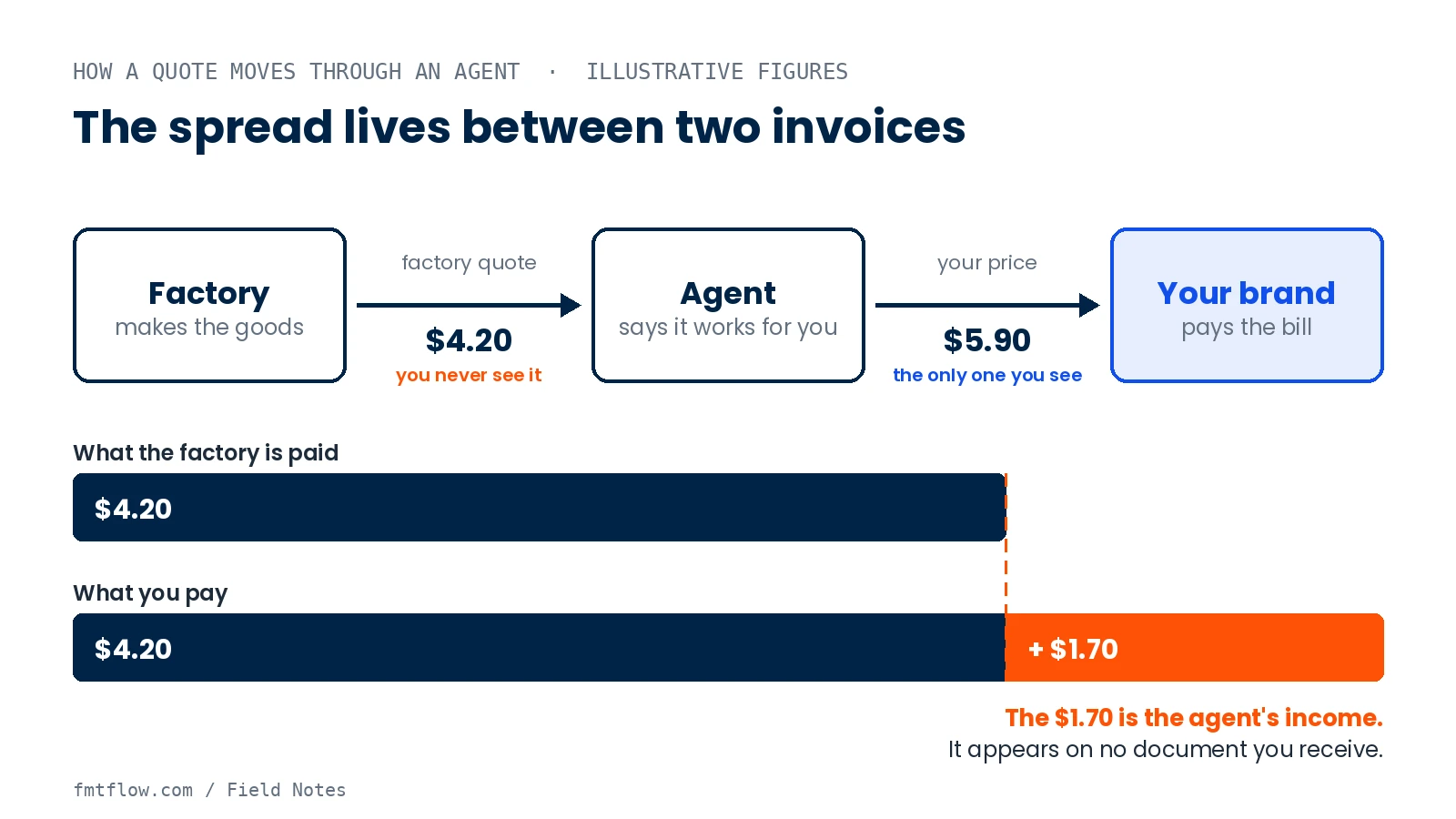
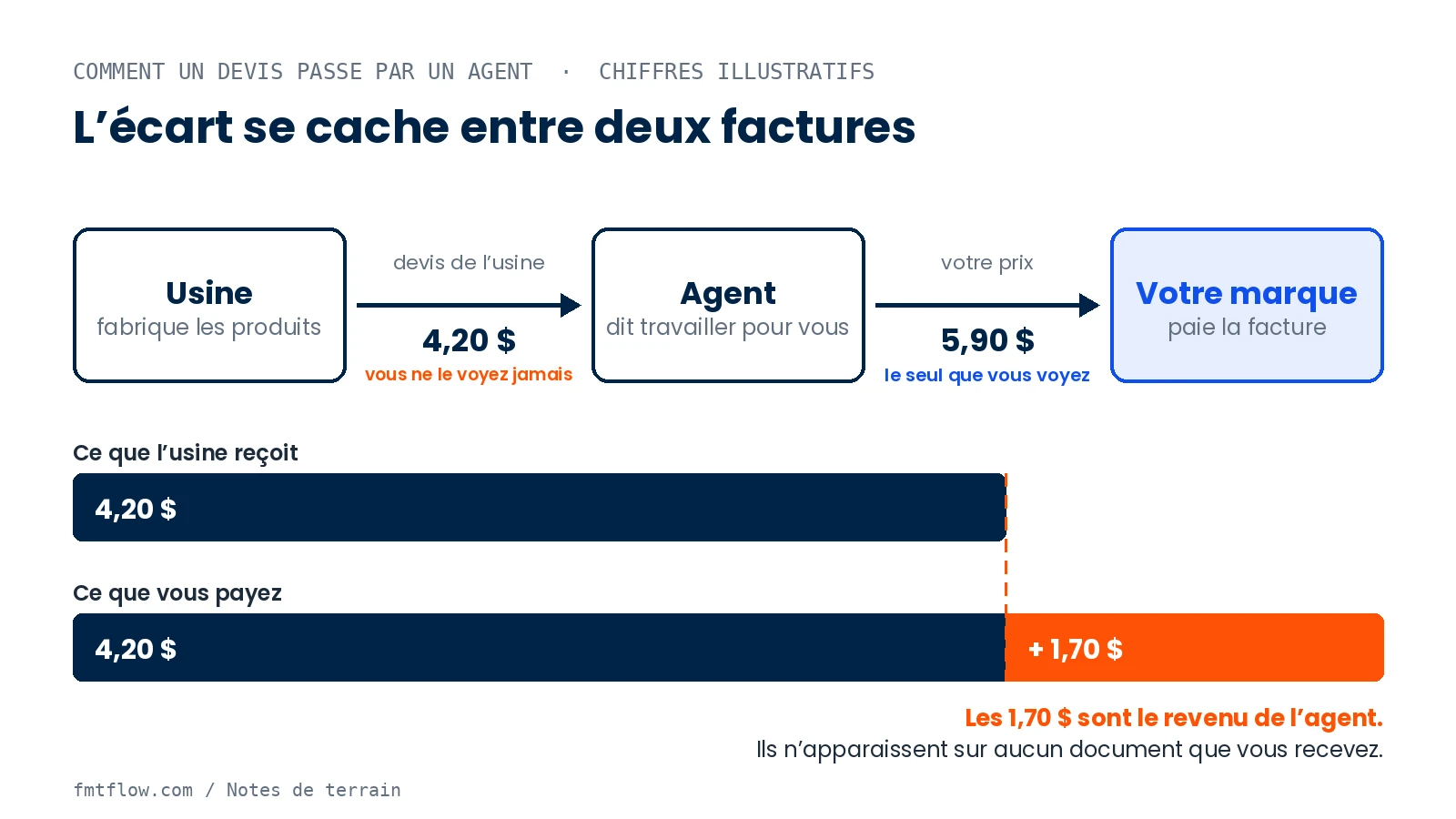
You send your tech pack to your agent. The agent sends it to a factory, usually one they've worked with for years, on terms you'll never see. The factory quotes the agent a real price: say $4.20 a unit, ex-works. The agent quotes you $5.90, FOB. The $1.70 spread is the agent's income. It doesn't appear on any document you receive. Your invoice says $5.90, the factory's books say $4.20, and the difference lives in the space between two companies you can't see into at once.
Nothing about this is illegal. In much of the industry it isn't even considered dishonest: it's simply how the trade has always priced itself. But you should understand what it does to every decision your agent makes afterward.
One distinction matters here. A trading company or contract manufacturer that sells to you openly, as your vendor, is doing something different: you know you are buying from a reseller, you negotiate its price as a price, and for some products (consolidation, custom packaging, small mixed runs) it is the right call. The problem is not resale. It is an agent who says it works for you while being paid from the other side of the table.
Why the agent seems free
The spread explains a pattern that confuses many founders: agents who seem to work for free. Free sampling. QC included. No service fee. None of it is free: it is paid out of the margin, which means by you, at a rate you never agreed to and cannot audit. We take that bundle apart in The 'Free' Services Your Sourcing Agent Gives You.
The follow-on order game
The spread also isn't static. The first order is often quoted lean. The agent wants you committed. Once your molds are at the factory, your samples are approved, and your launch date is fixed, the price starts moving. Raw material surcharges. A "factory adjustment." Currency movement that only ever moves one way.
Some of that can be real; costs do change. The problem is you have no way to tell. You can't see the factory's quote, so you can't see which increases the factory asked for and which ones were added in transit. Switching feels impossible (the factory relationship, your tooling, your production knowledge all sit with the agent), so you pay.
What the spread does to quality and time
Money is only half the damage. The deeper cost is what the structure does to information.
An agent paid from the factory's price is, structurally, on the factory's side of the table when things go wrong. Its income comes out of the factory's invoice, so pushing the factory hard on a defect means pushing on its own paymaster. A production problem surfaced early is a difficult conversation with you; surfaced late, it's a fait accompli you have to accept. You will tend to hear about problems when nothing can be done about them anymore. Not because anyone is evil, but because every incentive in the chain points that way.
If you've ever approved a beautiful sample and received a mediocre production run, or learned about a three-week delay four days before your launch, you've felt this structure working as designed.
How to know if this is happening to you
Ask yourself four questions:
- Do you know your factory's name and address, and could you contact them directly if you had to?
- Whose name is on your invoices: the factory's, a vendor you chose, or a company your agent controls?
- Have you ever seen the factory's own quote, or only a price that arrived through the agent?
- What happened to your price after the first order?
If the answers are no, the agent's, never, and it went up, you're not paying a fee for a service. You're inside a spread.
The structural fix
The fix isn't finding a more honest agent. It's changing the structure so honesty isn't a personality trait, it's a mechanical consequence.
That means: you own the supplier relationship (names, contacts, contracts), whether you buy from the factory itself or from a contract manufacturer or trading company you chose. You pay your supplier directly, at a price you negotiated with it, so there is no hidden second spread. Whoever operates the day-to-day for you is paid by you, a fee you see, for work you can inspect. And when you need a new factory, whoever looks for it should hand you the full list: every candidate by name, the quotes, what they saw on the visit, and a direct introduction to the one you pick. Every quote, every price change, every inspection result is logged where you can read it, while there's still time to act on it.
This is how FMT Flow is built to work. We're not an agent and we never take title to your goods: we operate the link between your brand and your suppliers, embedded in your team, on your systems. Your suppliers quote you. You pay them directly. Our fee is a published rate on what you ship, it is the only money we make, and it's on your books, not buried in your unit price.
The question to ask this week
Whatever you do next, start with one email to your current agent: "Can you share the factory's original quote for my last order?"
The answer, or the silence, will tell you which structure you're in.
If it's time to change it, talk to us. We'll give you a straight read on whether your operation is a fit for the way we work, and if it isn't, we'll say so.